How’s it going? If you’ve ever hooked up a trailer and felt that little shimmy in your steering wheel, or watched your rearview mirror with a knot in your stomach as your trailer swayed back and forth, you know exactly what I’m talking about. That feeling sucks, right? You white-knuckle the whole drive, your passengers are on edge, and what should be a fun trip becomes a major source of stress. For real, it can turn a beautiful day into a total bummer. But what if I told you that a huge part of that instability isn’t about your truck or your driving skills, but about one simple, often overlooked piece of equipment? What if there was a smarter way to hook up your trailer that could transform your entire towing experience? My friend, that smarter way is already here, and it’s called the adjustable ball mount. Let’s dive in and get you towing with confidence.
Why Your Standard Hitch is Holding You Back
Let’s be real for a second. Most of us start our towing journey with whatever hitch ball and mount came with the used trailer we bought, or we grab a cheap, fixed-height model from the local big-box store. It seems fine, right? You bolt it on, hook up, and off you go. But here’s the thing they don’t tell you: a one-size-fits-all approach is a total myth in the towing world. Think of it like trying to wear a shoe that’s two sizes too big; you can technically walk, but you’re going to be clumsy, inefficient, and you might even hurt yourself. Your truck’s receiver height and your trailer’s coupler height are almost never a perfect match. This mismatch creates an angle, and that angle is public enemy number one for towing stability. When your trailer isn’t sitting level, you’re essentially fighting physics the entire trip. Can you imagine trying to push a heavily loaded dolly that’s tilted forward or backward? It’s a nightmare. That’s exactly what you’re asking your vehicle to do.
The Hidden Dangers of an Improper Tow Angle
So, what’s the big deal with a little angle? Oh, come on, it can’t be that bad, can it? Absolutely, it can. An unlevel trailer does a lot more than just look awkward. First up, you have uneven weight distribution. If the trailer is nose-down, you’re putting excessive weight on the rear axle of your tow vehicle. This can cause your front end to feel light, making your steering less responsive and your headlights to point up into the trees instead of at the road. That’s crazy! Conversely, a nose-up attitude shifts weight away from your tow vehicle’s rear axle, which is a classic recipe for the dreaded trailer sway. I’m talking about that sickening fishtailing motion that can quickly turn into a full-blown jackknife if you don’t catch it. Furthermore, you’re putting massive, uneven stress on the trailer frame and your tires, leading to premature wear and a real risk of a blowout. It’s a long shot to think a fixed hitch will work for every trailer you’ll ever own, and honestly, that’s a gamble you just don’t need to take.
Unlocking the Power of an Adjustable Ball Mount
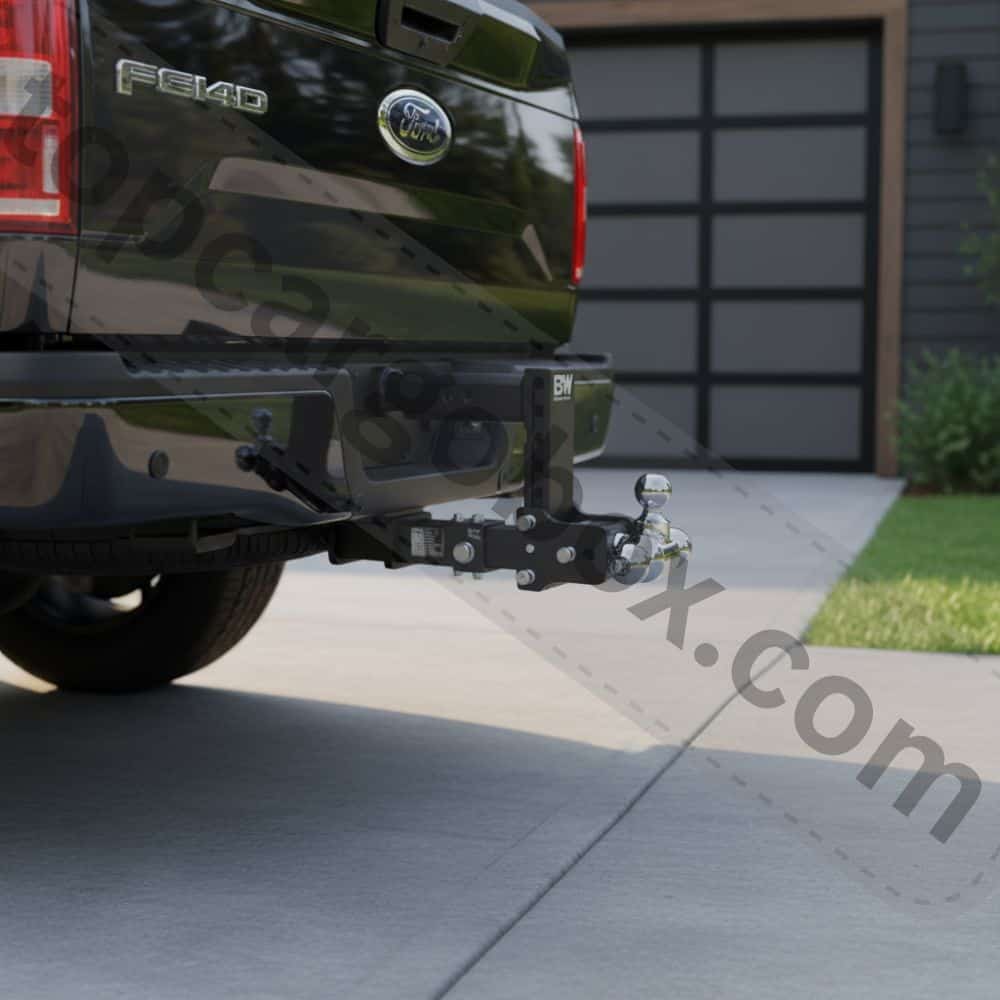
Alright, enough with the scary stuff. Let’s talk about the solution that’s going to make your towing life a thousand times easier. An adjustable ball mount, like the legendary B&W Tow & Stow, is basically the Swiss Army knife of the towing world. It’s designed from the ground up to solve the leveling problem with legit simplicity and brute strength. Instead of being a single, rigid piece of steel, it features a main shank that slides into your receiver and a movable head that can be raised or lowered through a series of pin-setting positions. This isn’t some minor convenience feature; it’s a complete game-changer for achieving a perfectly level trailer. You get to fine-tune the height of your hitch ball with incredible precision, ensuring that your trailer is riding flat and true, just like the engineers who designed it intended. How awesome is that?
Key Features and Specifications at a Glance
Off the top of my head, I know specs can be a bit dry, but stick with me because this is where you see the real value. Let’s break down what makes a top-tier adjustable ball mount so special, using a top-selling model as our benchmark.

Feature & Specification | Details |
|---|---|
Core Function | Height-adjustable ball mount for achieving a level trailer. |
Receiver Hitch Size | Fits a standard 2.5-inch receiver. |
Ball Capabilities | Often features a tri-ball setup (1-7/8″, 2″, and 2-5/16″) for incredible versatility. |
Adjustment Range | Offers a significant range of motion, for example, a 7-inch drop capacity. |
Gross Towing Weight (GTW) | A massive 18,000 lbs rating on some heavy-duty models. |
Tongue Weight Capacity | Typically a robust 1,800 lbs or more to handle serious loads. |
Construction Material | Forged from high-strength American-made alloy steel. |
Durability & Finish | Protected by a rugged powder-coated finish to resist rust and corrosion. |
Stowability | Designed to rotate and stow neatly under the vehicle when not in use. |
Security | Often includes an anti-theft design, requiring a lock for removal. |
Warranty | Backed by a solid Lifetime Limited Warranty for peace of mind. |
How Proper Leveling Transforms Your Tow
Let’s get into the nitty-gritty of why getting level is such a big deal. When your trailer is perfectly level, its frame is parallel to the ground. This means the axle is sitting squarely under the load, and the weight is distributed evenly across all the trailer tires. For your tow vehicle, this balanced state maximizes the tongue weight pushing down on the hitch. That downward force is your best friend; it creates stability by planting your rear tires firmly on the pavement. You’ll notice the difference immediately. The truck feels more planted and solid. Steering inputs feel crisp and confident. When a semi-truck blows past you, you won’t get that heart-stopping push of air that starts the sway cycle. Your trailer will just track behind you, calm as can be. It’s the difference between wrestling a wobbly shopping cart and pushing a perfectly balanced wheelbarrow. Same weight, totally different experience.
Beyond Leveling: The Surprising Perks You’ll Love
Okay, so we’ve established that an adjustable ball mount is essential for stability. But wait, there’s more! These clever devices are packed with features that solve other common frustrations you probably didn’t even know you had. Take the stowability factor, for instance. How many times have you whacked your shin on a hitch that was left in the receiver? Tell me about it! It’s like a magnet for bare skin. With a design like the Tow & Stow, when you’re done towing, you simply rotate the entire assembly up and under your vehicle, locking it securely out of the way. No more shin-busters, and no more worrying about scraping it on a steep driveway or smashing it into the garage door. That’s lit!
Versatility That Saves You Money and Hassle
Another huge win is the multi-ball setup. Old-school thinking meant buying a separate hitch mount for each different ball size you needed. If you have a utility trailer, a boat, and a camper, that’s three different hitches cluttering up your garage. Forget it! A tri-ball adjustable mount consolidates all of that into one single, rugged unit. You just rotate the head to the ball size you need, pin it, and you’re ready to go. This isn’t just a space-saver; it’s a legit money-saver over time. Plus, you’ll never be caught at a friend’s house ready to help them move a couch, only to realize you have the wrong ball size. You’ll always be the hero, prepared for anything. Sounds good, right?
Putting It All Together: Your Step-by-Step Setup Guide
I get it, all this talk is great, but how do you actually use one of these things? No worries, it’s surprisingly straightforward. Let’s walk through it. First, you need to determine the ideal height for your ball. Park your tow vehicle and trailer on level ground. Measure from the ground to the top of your trailer’s coupler. Then, measure from the ground to the inside bottom of your truck’s receiver hitch. The difference between these two numbers tells you how much rise or drop you need. If your receiver is lower than your coupler, you need a hitch with a rise. If your receiver is higher, you need a drop. The magic of the adjustable mount is that it can usually cover both scenarios within its range.
The Fine-Tuning Process for a Perfect Tow
Once you have your target height, it’s time for the easy part. Pull the two stainless-steel adjustment pins on the side of the hitch. You might need to give them a little grunt, but they’re designed for a smooth operation. Slide the head up or down to the hole that most closely matches your required height. Re-insert the pins, making sure they click securely into place. Now, double-check your work. Hook up the trailer and take a step back. Does the trailer look perfectly level from the side? Use a level on the trailer frame if you want to be super precise. If it’s not quite right, no big deal, just pull the pins and adjust one more notch. This whole process takes less than five minutes, but the payoff in safety and peace of mind is absolutely massive.
Investing in Peace of Mind: Quality and Warranty
When you’re dealing with the safety of your family, your expensive toys, and everyone else on the road, you don’t want to cheap out. That’s for sure. This is where paying attention to the build quality and the warranty really matters. A premium adjustable ball mount is an investment, but it’s one that pays dividends every single time you tow. Look for products made from high-strength American-made steel. Why does that matter? Because U.S. steel mills have incredibly controlled processes and specifications you can trust. Where the strength and flexibility of the steel can mean life or death, that’s a detail you don’t want to compromise on.
The Assurance of a Lifetime Warranty
And then there’s the warranty. A company that offers a Lifetime Limited Warranty is a company that stands behind its product, 100 percent. They are confident that their products are made without design or quality defects. This means that if anything goes wrong under normal use, they’ve got your back. They’ll work to get you back on the road with as little cost and hassle to you as possible. That kind of commitment tells you everything you need to know about the integrity of the product and the people who make it. When you buy a B&W, for example, you’re buying from employee-owners in Kansas who take immense pride in their work. You’re not just buying a piece of metal; you’re buying a promise of safety and reliability.
Your Next Steps Toward Confident Towing
So, where do you go from here? Well, if you’re tired of the stress and ready to transform your towing from a white-knuckle chore into a chill, confident experience, the path is clear. Take a look at your current setup. Think about the last time you felt that trailer sway. Remember the hassle of storing multiple hitches. Then, consider the simple, elegant solution an adjustable ball mount provides. It’s one of those upgrades that, once you have it, you’ll wonder how you ever managed without it. The road is calling, and now you have the knowledge to answer that call with total confidence. Hit me up if you have any more questions, and take it easy out there.

Our team is creating outdoor-gear relevant articles with passion. If our articles can help you to find the correct solutions for your questions, we will be happy about that. In the content creation process, we usually collect accurate and useful information online or offline to compile our content in an organized way. Consequently, we can guarantee that you can discover some expected answers to your questions. We appreciate your time on our site.